
The information from my presentation at the “In God’s Image” Disability Ministry Conference, sponsored by the Archdiocese of Galveston-Houston, held at the University of St. Thomas on 11/12/16. It was updated for the Dominican Sisters Training on 6/11/18 for the Dominican Sisters Training.
3 Ways to Approach Music
-Background/Atmospheric Music
- Putting on background music, CD players with instrumental music (an ADDITION to usual teaching)
-Passively Using Music to Teach
- Choosing materials that have songs/music included, but no activities for the students other than watching/learning to sing the song
-Actively Using Music to Teach
- Moving to the music, involving multi-sensory approaches
1. Background/Atmospheric Music
-Why do I use background music? What is my purpose?
- Creating a calming learning environment
- Helping students to focus
-How do I choose the correct music?
- Wordless, not distracting
- YouTube searches (but MAKE SURE you watch the entire thing all the way through before presenting it to students!)
-When do I use this kind of music?
- In the beginning of the session, to create a calming atmosphere
- In the background during workbook or writing/coloring tasks
-When would this NOT be appropriate?
- If a student is highly distracted by the music
- If any student is becoming agitated when the music is playing
- When I am using music to passively or actively teach (PAUSE the background music!)
-EXAMPLES
- Calming Background Music YouTube playlist: https://www.youtube.com/playlist?list=PLzBZM7vM3h1Apl3kfV0Oqpro-t0XzDNEg
- YouTube (search for prayers)
- https://www.youtube.com/watch?v=HwsQf02phgw
- https://www.youtube.com/watch?v=8Ndu5BsR6es
- Guided Meditation
- “Meeting with Jesus” (SEE BOTTOM OF POST)
2. Passively Using Music to Teach
-Why would I choose a song with a teaching concept over just telling them the idea?
- Music is processed differently in the brain (all over the brain) where speech is only in one small part
- How do we learn our basics in the English language (by rote or by song)?
- Creates neural pathways that allow the information to be brought up quickly.
- Example: Joy to the World
- SEEING IS BELIEVING:
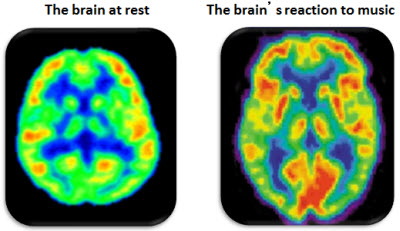
-How do I use music to teach?
- DON’T RE-INVENT THE WHEEL!
- YouTube.com is your best friend! Vacation Bible School also has great songs you can find on YouTube.
- Saying the Our Father? Why not sing it?
- https://www.youtube.com/watch?v=BhvvGTsqcCU
- Some examples of passively using music to teach:
- https://www.youtube.com/watch?v=rF54I_hsV34
- https://www.youtube.com/watch?v=Fnt-P38ykc4
- https://www.youtube.com/watch?v=xuG5I0K5W2w
- https://www.youtube.com/watch?v=iREM-5qcCjo
-When do I use this kind of music?
- Anytime you would like to teach a new concept! If you can put a song to new information, the students will retain the information for longer periods of time.
-When would this NOT be appropriate?
- For students who are distracted by the music
- When you could add another sense and make the music active!
- If the students are older and feel motions are too “babyish”
3. Actively Using Music to Teach
-Why would I actively use music to teach?
- When you engage more than 1 of the senses, the material is retained better and for longer periods of time!
-How do I use music to teach?
- Find songs with movements already added
- YouTube; students love watching videos with children like them
- Add movements to songs about Catholic concepts
-ADD MOVEMENTS!
- Fruits of the Spirit
- https://www.youtube.com/watch?v=DFumjSll68s
- Simple Movements
- https://www.youtube.com/watch?v=wlbLCIhSCmE
- VBS Songs/Dances
- https://www.youtube.com/watch?v=Vyb-H4k07ZU&index=7&list=PLTx0Vo23Wo5nnA2F6xLg-h–j_NwbSyjl
-CHANT/SHOUT
- Gifts of the Spirit
-
Wisdom *points hand up above head at God*
Understanding *holds hand flat over head—get it? standing under?*
Knowledge *points at the side of head*
Counsel *makes talky fingers by mouth*
Piety *folds hands below mouth*
Fortitude *makes muscle arm just below that* and
FEAR OF THE LORD *crouches with arms about body, trembling*
-
- “Bless us O Lord…”
-When do I use this kind of music?
- Whenever possible! Involving 3 or more of the senses allows the information to be retained quicker and for longer periods of time.
- If you can add motions, do it!
- If students are getting restless/come in riled up, throw in some movement to get the wiggles out!
-When would this NOT be appropriate?
- When students are getting out of control
- When working with students who think it is childish
- When using common prayers or responses said in Mass (it can be confusing for students to know when the movements are appropriate or not)
- Meditative or quiet reflection moments
Problem-Solving
- Can you think of any issues you would possibly have implementing some of these ideas?
- “I can’t sing!”
- It doesn’t matter how GOOD of a singer you are, the fact that you are singing AT ALL is what registers in the brain!
- My favorite quote: If you think you have a bad singing voice, sing twice as loud so God will hear you and give you a better one!!! 🙂 🙂 🙂
My e-mail:
- kelseybpena@gmail.com
GUIDED MEDITATION SCRIPT
Allow your mind to let go of everything that’s worrying you, everything that’s weighing you down. Allow yourself to be a blank slate, light as a feather, open and receptive to the messages you will receive today. Allow anything that you hear, smell, see, taste or feel to help you in your meditation. Help it to become part of the story instead of a distraction. God wants so much for you, allow him to show you His plan.
In your mind, stand up from where you’re sitting and walk towards the door. But when you open the door, you are instantly transported to a path in the forest. It is a beautiful day outside, the sun filters down through the leaves, making soft shadows all around you. There is a cool breeze to complement the warmth of the light as it rests on your shoulders. What do you see?
You start down the path, and you can hear the soft sounds of birds chirping in the distance. You can smell the sweet scent of flowers and citrus trees as you continue on your way. You can take your time here, there is nothing hurrying you. Let all thoughts empty from your mind, and allow yourself to be completely connected with God and nature during your journey.
In front of you, you see that you are coming upon a large clearing, a perfectly round meadow in the forest. In the middle of the field, someone sits on a large rock. You realize he has been waiting there patiently, waiting for you. He seems familiar even though you are sure you have never seen him before. His smile and his kind eyes light up as he sees you, and he reaches out his hand, beckoning for you to come near.
With great peace, you realize you are in the presence of Jesus. Your spirit leaps with joy as you encounter him. He pulls you into a warm hug and tells you, “My child! I am so glad you have come! Peace be with you.” How does that make you feel?
Jesus says, “I have a plan for you. Plans to prosper you, for your hope and future.” What else does he say? What specific message does he have for you and you alone?
Then Jesus invites you to draw deeper into your relationship with him. He knows your weaknesses and your failings but his love and forgiveness overpowers them. He calls you to open your mind and heart to him, to release the sins that are dragging you down. His blood will redeem them. What specifically is He calling you to change in your life? What can you do to bring yourself closer to God?
As your time with him winds down, you are left with a great sense of peace and healing. You know how much Jesus loves you and you know what you have to do to draw nearer to the kind of life He wants for you. As you give him one last hug, he draws the sign of the cross on your forehead and tells you to “Go in peace.” Remember this encounter, his words to you, and how you feel in this moment. Bring it with you as you head back down that path, as you reach another door at the end of the journey, and come back into this room. Keep your eyes closed and spend one last precious second basking in the love of Jesus. And when you’re ready, slowly open your eyes and come back into our room.
 musictherapymixtape